
Behind the Screen #7
Field Update

From the Maelstrom: A Project Update
This issue of Behind the Screen is a little late and briefer than I intended, but for a good reason. My work on Maelstrom: Space Operas in Cairn has become far more extensive than I ever imagined!
I hadn't realized how deep the rabbit hole would go, especially when adapting vehicles from other franchises into Cairn's mechanics. At the moment, I've brainstormed a list of 85 vehicles inspired by various sci-fi IPs. I'm still figuring out if all 85 will make the final cut or if I need to pair it back for simplicity. I've also run into a few bumps tracking backgrounds. I have 12 nearly completed and am currently evaluating if I truly need 20, as in Cairn 2e.
All this to say, a source zine project involves many choices, and it's easy for the scope to creep. I constantly remind myself that each layer of complexity has the potential to slow down the game's flow.
With all that said, summer is nearly over! Make sure to get out there and enjoy the nice weather—and touch some grass—or in the case of my kids, water!

Conversion Workshop
Originality is difficult. There’s really no way around the fact that in most spaces, there is truly nothing new under the sun. On its face, I don’t think this would matter so much if individual creativity weren't far more prevalent than 'originality'. We’ve all likely been in the predicament of hearing a story, falling in love with it, and then considering all the ways it could have played differently—or maybe that’s just my specific brand of anxiety talking! Regardless, today I’m diving into the part of this hobby's pool many find daunting: adapting material from other works into our own.
In creative endeavors, there’s a fine line between inspiration and appropriation. Imagine for a moment that you try an unfamiliar flavor of ice cream at a new shop. To your delight, it’s the tastiest ice cream you’ve ever had! A week later, you're still thinking about that 'perfect scoop.'
Now, imagine you have all the equipment and ingredients to make ice cream yourself at home. Appropriating that perfect scoop would be reproducing the shop's recipe and then telling everyone you made it yourself—maybe even trying to sell it. Conversely, being inspired by that perfect scoop would look similar, with one key difference. You might use all the same ingredients you remember, but you leave out one or two and add another. It's not an exact copy; instead, it's your unique interpretation of that experience, with different details added in.
In a 1903 letter he wrote to Helen Keller, the great American author Samuel Clemens (Mark Twain) shared a profound observation on this topic:
“There is no such thing as a new idea. It is impossible. We simply take a lot of old ideas and put them into a sort of mental kaleidoscope. We give them a turn and they make new and curious combinations…they are the same old pieces of colored glass that have been in use through all the ages.”
This passage is particularly meaningful because Clemens was responding to a controversy surrounding a story Keller had published, which some thought was plagiarized—directly stolen and reprinted from another writer’s work.
Mark Twain’s message was not that stealing ideas is okay. The kaleidoscope imagery captures the heart of true creativity: the key to making something new is to combine good ideas we've encountered, creating something entirely unique in the process. Your perspective is singular and unique, and your expressions are valid interpretations of your experience. For years, I lost time as a writer because I was too concerned with pure originality and wouldn’t let myself just tell a story.
In my opinion, based on my experience and input from other professional writers, it is more fruitful to get the concepts you have out on paper and then edit back from those edges that are too direct, or too close to "rip-off" territory. When applying this maxim to converting things from IPs for use at your table, remember that the mechanics you're trying to implement are generally more vital to your players’ experience than the 'skin' or presentation. Therefore, I offer you this method:
Step 1: Dream/Conceive
It may seem obvious, but to pull off a conversion, you must first determine what you'd like to convert! Lately, I’ve been adapting things from multiple Space Opera IPs (Star Trek, Star Wars, WH40K, etc.). While 'dreaming' about the most compelling aspects of these IPs, I determined that 'the Force' would likely be something worthy of adaptation. Target acquired! Now, on to step 2.
Step 2: Define and Assess
Once you have a concept you wish to adapt, it's time to dig into it from a different angle. Evaluate what your element does within the original IP. In my example, the IP doesn’t have fantasy-style magic. I also noted that 'the Force' is a clear stand-in for that type of energy, allowing users to augment reality, produce elemental manifestations, and change the physical properties of things. To me, and the internet, 'the Force' is essentially the Star Wars version of magic. I needed to consider whether my adaptation would replace or augment some element of my game’s mechanics. When considering what to do with 'the Force', I looked at how it would behave within the framework of Cairn. I noted that it's a lot like Psionic Magic. In the interest of simplicity, I opted to replace the Cairn Magic in Maelstrom with this new psionic, metaphysical system. I looked for how manifestations of 'the Force' were described, and I made a list pulling from the IPs' films, books, and video games. I was ready for step three!
Step 3: Grind/Shape
Armed with my list of desired manifestations, I began workshopping ways to make dice tell the story. I considered something small at first—how to make a target willingly disarm themselves with a 'Mind Trick.' I had to ask myself, "What are the core rules of Cairn?"
Emphasis on simple mechanics.
Inventory focus (fatigue).
Three main ability scores (Strength, Dexterity, Will).
D20 Roll-Under system.
Saving Throws—Stated actions automatically succeed.
I needed to work within these five points to bring my force to bear at the table. This required me to evaluate what the Cairn magic system already does:
Read from one spellbook at a time.
Occupy both hands.
Take Fatigue despite casting outcome.
Additional saves by the caster depending on context.
Anyone can do magic.
If the maxim within Cairn is that all stated actions automatically succeed, then the five items on the list above function as limiters. Limiters, in my opinion, are what make game mechanics fun! They are the points of conflict that make a narrative moment's success so much sweeter. So here’s what I came up with:
No more spellbooks, but learned 'manifestations'.
Users devote their entire action in the round they use a manifestation.
Each manifestation has an associated fatigue cost.
Manifestations may require additional saves from both the user and the target.
While access to the manifestations is linked to several player backgrounds, any PC may attempt to determine if they are sensitive to my yet-unnamed 'force’.
I had a general model of the system I had conceived of—but it wouldn’t be wise to simply set it out into the wild like I did when the request for this type of adaptation was first made to me! That means I was ready for the next step.
Step 4: Playtest
I can’t emphasize enough how crucial it is to test the mechanics you intend to unleash on your players. Not only is this practical for you as the game runner, but it also preserves your rules in the long run. Part of being a TTRPG player is exploiting or ‘breaking’ the game. The Warden’s job is to present conflicts, and the players’ job is to thwart or avoid them. If you don’t have a solid understanding of the mechanics, your conflicts will largely be insignificant. I sat down and played both sides of an encounter between two PCs using this new magic system. Here’s what I learned:
Some manifestations need a lingering effect on their targets, or they become pointless, particularly in combat.
This system absolutely needs to be tied to the same Fatigue/Inventory system for balance.
The system favors PCs that specialize in its use.
Appropriate use can be deadly for both the target and the user.
This playtesting left me with unanswered questions, such as, "Should there be more defensive manifestations?" and "Should there be a manifestation that either negates or thwarts taking fatigue?" This brings us neatly to the penultimate step.
Step 5: Refine
Remember that each limiter stands to deepen the richness of your players’ experience as much as it stands to slow or break it. I still don't have solid answers to those two questions above. I haven’t decided whether I even want to answer them or leave that open to other Wardens. I still haven’t fully released the system, meaning there’s time to consider and playtest. It all comes down to negotiating what you and your players are willing to manage at your table. I keep a document called 'Work Scraps' for rule concepts that I like but can't apply to the current project. Sometimes the best ideas have to simmer on the back-burner until their best application presents itself; but they're still your ideas, and they're still valid. Hold on to them!
Step 6: Polish
After testing your adapted mechanic and smoothing as many rough edges as possible, you’ve reached the final step—making sure your adaptation has strong points of departure from the source material. In my example, 'the Force' is a copyrighted term. I can’t call my version 'the Force,' even if it’s the most descriptive word for it. I have to come up with my own way of describing my psionic magic system.
In many ways, I re-ran steps 1-5 to determine what I would call my 'Force'. I considered how I might explain or rationalize my psionic magic system in my space-fantasy adaptation. I looked at various forms of matter and movement in physics and determined that sound waves were the most compelling form similar enough in actual function to what I wanted my system to present as. Therefore I dubbed it, 'the Thrum'—the great wavelength that transcends time and space. Once there’s a proper name for an element like this, things get far easier to categorize. Instead of a character being 'Force-sensitive,' they are now 'Thrum-sensitive'. Obviously this doesn’t solve every problem, like what to call a 'Jedi' or 'Sith,' but it is the first of many metaphorical boxes I can start putting other concepts into. Once one problem is solved, I get to solve another, reapplying the six steps I’ve described.
Perhaps while reading this, questions like, "What about the Empire?" or "What do I call a Lightsaber?" have occurred to you. I’ve already solved those problems myself, but I invite you to engage with any of your questions using this method and share them in the comments! It will be fun to see where we harmonize and where your creativity expands!
Name our First Zine… And give it a cover!
Our first Summer Zine, a collection of Cairn-compatible content based on North American folklore, is coming to life. We need YOUR help to give it a title and a striking visual identity. The winning entry will be featured on the final product, so get your creative gears turning!
To submit an image for consideration:
Make your submission either in a paint program, or by hand. Hand-made submissions must be in ink and or color.
Send your submission digitally to editorbehindthescreen@gmail.com with ‘Zine Cover’ as the subject line.
Make your submission before 11:59 on September 4th.
To submit a title for consideration:
Send your submission to editorbehindthescreen@gmail.com with ‘Zine Title’ as the subject line.
Make your submission before 11:59 on September 4th.
Make as many submissions in either category as you wish!
RPG HQ IS GO!
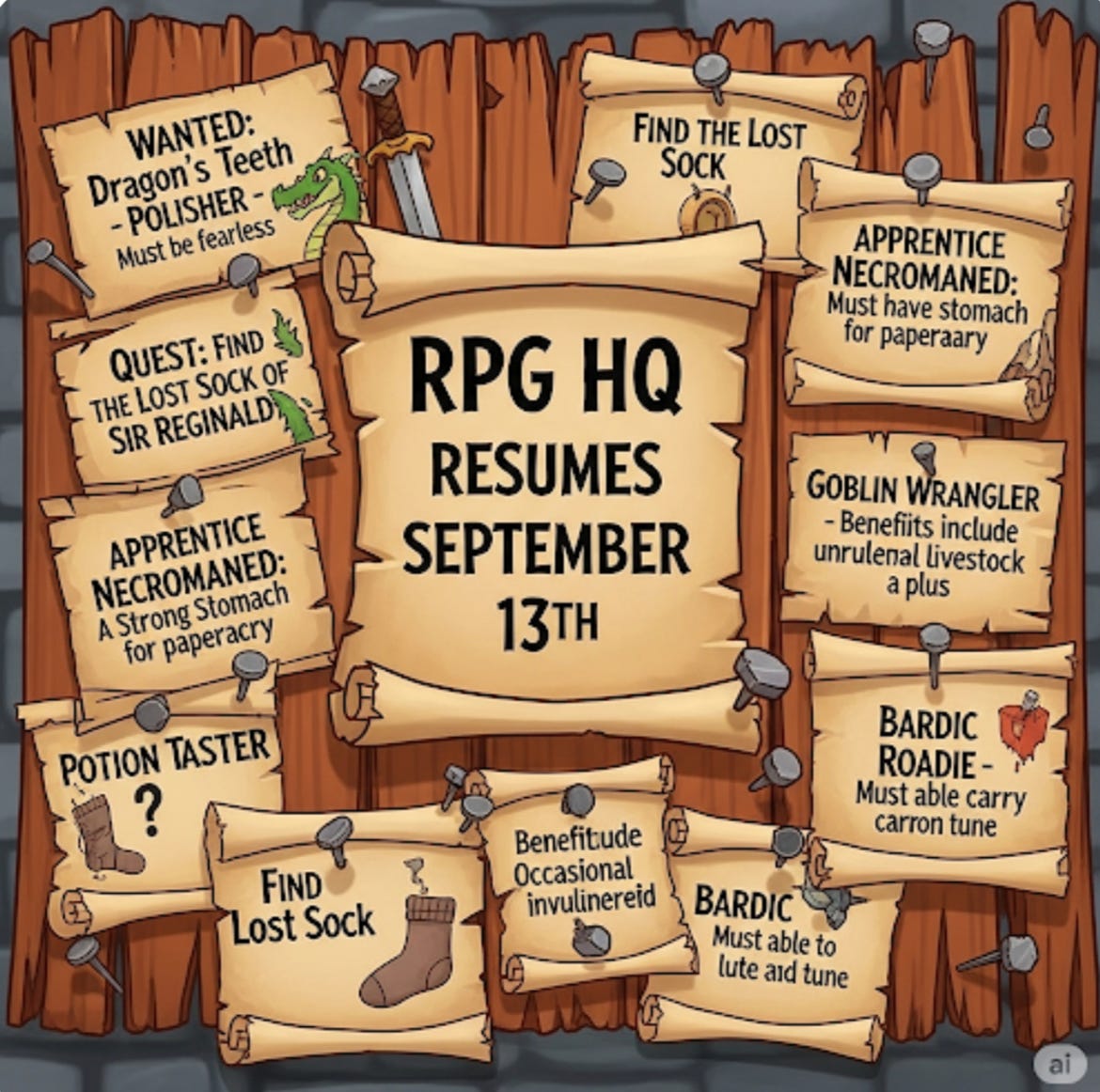
RPG HQ is starting up again on September 13th! Get your calendars ready and join us at the Hennepin County Library - Rockford Road, 6401 N 42nd Ave, Crystal, MN 55427, from 10:00 AM to 2:00 PM. We can't wait to see you back at the table!(RSVP for this event here!)
FUTURE DATES
Saturday, September 27th —— Location TBD
Saturday, October 11th —— Location TBD
Saturday, October 25th —— Location TBD
Saturday, November 8th —— Location TBD
Saturday, November 22nd —— Location TBD
Can you help run a game?
RPG HQ is a community event, and we rely on the generosity of our volunteer game runners to make it happen. If you're interested in running a game of Cairn or any other RPG, please reach out to us! You'll be helping to create a welcoming space for new and veteran players alike!
What kind of Cairn do you want to play?
We're putting together our schedule and would love to know what you want to play. The month of September is reserved for Cairn, and Cairn adjacent rule sets. There are a lot of options, from vanilla Cairn 2e to the new Maelstrom setting, or even other games that use the Cairn system, like We Deal in Lead. Please take a moment to vote in our poll and let us know what you'd like to see at the table!(I’ve only gotten two responses so far, and they’re split 50/50!)