
Behind the Screen #8
Creator Introduction


From the Desk of the Editor
It feels fitting that the final issue of this publication for the month of August, the eighth month, should be the eighths issue. What an absolute whirlwind the past three months have been! Perhaps like me, you’re wondering where your summer time went…
An Interview with the Creator of Cairn Session 1
I'm honored to share an exclusive correspondence I had with Yochai Gal, the author and creator of the celebrated TTRPG, Cairn. His game is a staple in my own toolkit, so I was thrilled to get a chance to ask him about its unique design, the philosophy of creativity, and what's coming next for his games.
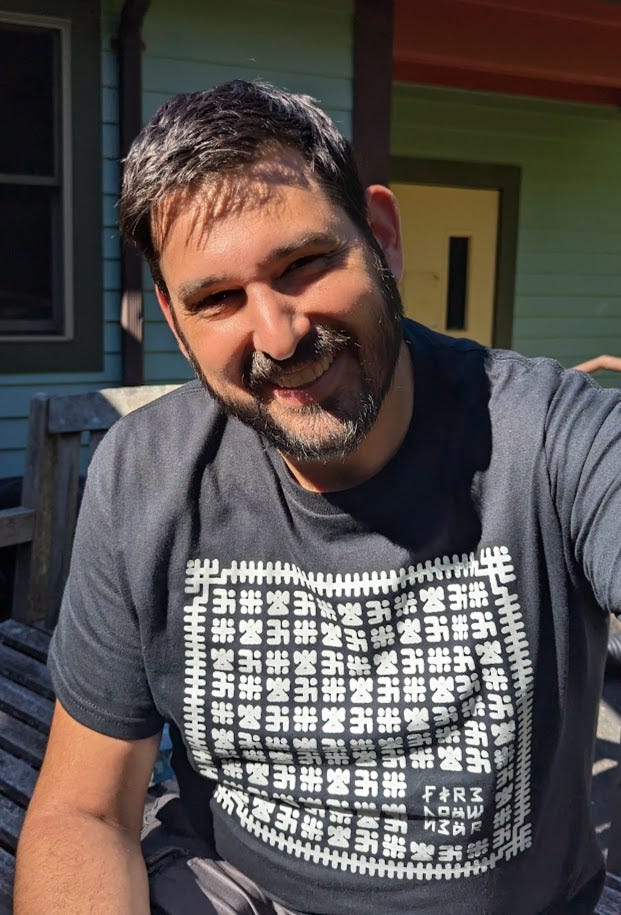
His answers were so insightful, I couldn’t bear to cut them down. So, I’ve organized the full interview into four key sections to make it easier to read.There’s also far too much content for just one issue, so you can expect more in at least the next two weeks. Let’s dive in!
Part 1: On The Philosophy of Cairn
From the start, Cairn feels different from other games. It's often praised for its simplicity, but as Yochai explains, that simplicity is a deliberate design choice. In this section, he talks about the principles he adopted and the intentional gaps he left for players and Wardens to fill.
1.) TM: There are several different genres of game that I’ve seen Cairn categorized into. How do you define Cairn regarding its genre?
YG: If by “genre” you are referring to its themes, I’d say “dark forest fantasy with a touch of whimsy, inspired by folk tales of Eastern Europe and the British Isles.” However, Cairn 2e expands on that a bit by adding more thematic compatibility with traditional D&D-esque fantasy, minus the classes.
2.) TM: In designing your game, were your design decisions informed more by what you consistently saw in TTRPG rules, or what you rarely saw?
YG: That’s a great question. I’m not sure it’s either, really.
I spend a lot of time thinking about survivorship bias, which the statistician Abraham Wald highlighted during World War II. When the Allies studied planes returning from combat, they saw bullet holes clustered in certain areas. At first, people thought they should add armor where the holes were. But Wald pointed out the real insight: those planes survived despite being hit there. The ones that didn’t come back had probably been hit in the untouched areas, so that’s where the armor was really needed.
When engaging with rule systems, I try to keep this sort of thing in mind; that is to say: what is the significance of “gaps” in a rule system? How do rules lend themselves to that “fruitful void” Vince Baker talked about? Sean McCoy (creator of Mothership RPG) has said he explicitly did not write rules for stealth, despite the frequency in which PCs engage in stealthy behavior. His expectation was that the GM and players would have a conversation and then make decisions based on that dialogue, rather than relying on dice rolls for stealth. I like the idea of leaving certain aspects of the game open to interpretation and negotiation and letting the game happen “in between the rules.”
Part 2: On Collaboration and Creative Process
3.) TM: The game is built on a "third-party license" and is an evolution of several other games, like Into the Odd and Knave. How do you view this collaborative, open-source approach to TTRPG design?
YG: Knave 1e was released under a CC-BY license, which allows anyone to modify and release their own version of the game (including its text, tables, and so on) under whichever future license they choose to adopt. The Into The Odd family of games didn’t actually have a license (the “Mark of the Odd”) at the time of Cairn’s original release, so I simply borrowed the mechanics which could not be copyrighted. I’m good friends with Chris McDowall (the author of Into The Odd) and received his blessing, of course.
I chose to release Cairn under the more explicitly open source CC-BY-SA license, which like CC-BY allows for anyone to modify the original text of the game. Crucially however it also forces the creator to release their game under the same license, similar to the GPL 4.0 license in the open source software movement. And so games like Runecairn and Liminal Horror were subsequently released under the same license, as were their derivative works!
Personally I much prefer this model over the “do whatever you want” philosophy of CC-BY. It lets designers copy my work (all of it - everything I’ve ever written is CC-BY-SA!) but forces them to do the same. And since mechanics aren’t copyrightable anyway, designers wishing to avoid that license can still find inspiration in my games without worry of legal repercussions. They can even borrow “pieces” of my games (e.g. Spellbooks) and release only that portion as CC-BY-SA, retaining their copyright over everything else.
4.) Many designers struggle with knowing when to stop adding features. How do you decide when a game is "done," or when to release a new version?
YG: Every rule begins as a question. “How should treasure weight work?” for example. I’m a very selfish designer, so I really only like to write games that I want to play. I like games that are simple, low in math, and modular, leaving a lot of room for interpretation. That means that when I am developing a new rule, I try to keep any dependent rules to fewer than two, and if the new rule requires the creation of another new rule (rules creep!) then I consider dropping that new rule altogether.
Take for example the rule that “A bag of coins worth less than 100gp is petty and does not occupy a slot.” This rule depends on the player knowing what petty means and what a “slot” of inventory is (gp is a given at this point). I considered many alternatives to this rule, but none passed the “will Yochai enjoy it” smell test. It isn’t right for every table of course, but as very few rules depend on it players can very easily swap it out for something else.
5.) Your work is a significant presence on itch.io. How has that platform influenced your development and distribution process?
YG: I distribute my work via Google Drive, DTRPG, Itch, Lulu, Amazon, and so on. I spend a lot of time curating collections on Itch.io; and I appreciate the website’s tech-forward approach to managing releases (see Butler for more). I also like their business model, despite everything I do being free to download. Itch is a nice place to interact with folks interested in Cairn as well.
Part 3: On Community and The Future of TTRPGs
6.)TM: The Cairn community is very active, with many creators making their own content for the game. What's it like to see others build upon your foundation?
YG: Great! That was the point all along. Liminal Horror, Monolith, etc. are all awesome and save me a ton of time for when I want to play those types of games. Now I don’t need to write them myself, right? The beautiful thing is, they don’t take away from Cairn. They build on it, expand upon it. There is nothing lost.
7.)TM: Where do you see Cairn heading in the next few years? Are there any plans for new supplements, expansions, etc?
YG: I’ve written about 6 modules that are not yet published. We are currently putting the finishing touches on layout and art for Cairn Adventure Series 3, which will be a folk horror forestcrawl. My first playtest ended in a TPK! After that I have an adventure in the Roots (deep underground) and another in a haunted mansion. I have been working on a “Cairn 1.5” edition that essentially acts as a midpoint between Cairn 1e and 2e. The aim is to create a more first edition experience (no Backgrounds, lots of rolling during chargen) based on the more clearly-defined Cairn 2e ruleset. Finally, I plan on writing a city supplement in the future as well.
Part 4: The Fun Stuff & A Creator's Life
8.) TM: Besides other TTRPGs, what other forms of media—books, movies, art, video games—have influenced the tone and feel of Cairn?
YG: My favorite video game of all time is Nintendo’s Breath of the Wild. Rather than fawn over the lore (as so many Zelda-inspired games seem to do) I am more interested in its game design. BotW emphasizes exploration, discovery, and critical thinking over combat. It doesn’t provide for an emergent narrative experience, but it isn’t really trying to. Instead it lets players do almost anything they want and to go anywhere they want. Puzzles have multiple solutions and can be solved in almost any order. There is always something to be discovered around the corner, and how you choose to approach that something is up to you. For more on this, see Matt Walker's translation of CEDEC 2017 talks by Nintendo. It’s truly brilliant.
I love folk tales, and even wrote a module based on the thousands of Jewish folk tales I’ve read over the years. I find great inspiration from folk tales from all over the world; you can see my list of inspirational works here.
9.) Do you have a favorite memory from a Cairn game you've run or played in?
YG: (*Chuckles*) I personally hate hearing about other people’s games. It’s like asking about someone’s dream. If I had to throw something up I’d suggest folks watch some of my actual plays on my Youtube channel. Those people were pretty great to play with.
Next issue will follow the same format as this entry from the interview, as we get deeper into decision-making in game design, the Old School Revival/ New School Renaissance, and the art of games. Catch the next instalment Thursday, September 4th!
Name our First Zine… And give it a cover!
Our first Summer Zine, a collection of Cairn-compatible content based on North American folklore, is coming to life. We need YOUR help to give it a title and a striking visual identity. The winning entry will be featured on the final product, so get your creative gears turning!
To submit an image for consideration:
Make your submission either in a paint program, or by hand. Hand-made submissions must be in ink and or color.
Send your submission digitally to editorbehindthescreen@gmail.com with ‘Zine Cover’ as the subject line.
Make your submission before 11:59 on September 4th.
To submit a title for consideration:
Send your submission to editorbehindthescreen@gmail.com with ‘Zine Title’ as the subject line.
Make your submission before 11:59 on September 4th.
Make as many submissions in either category as you wish!
RPG HQ IS GO!
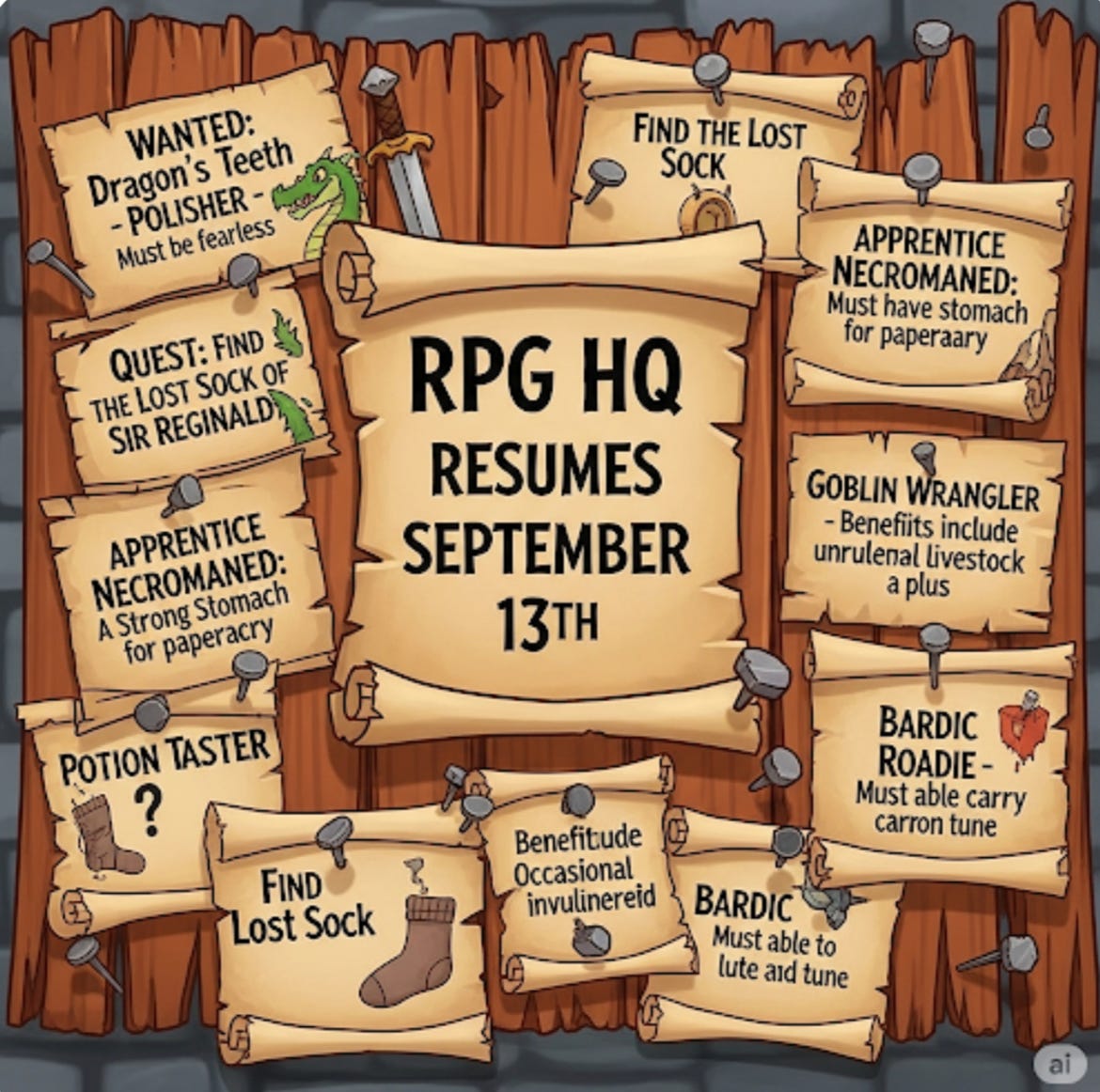
RPG HQ is starting up again on September 13th! Get your calendars ready and join us at the Hennepin County Library - Rockford Road, 6401 N 42nd Ave, Crystal, MN 55427, from 10:00 AM to 2:00 PM. We can't wait to see you back at the table!(RSVP for this event here!)
FUTURE DATES
Saturday, September 27th —— Location TBD
Saturday, October 11th —— Location TBD
Saturday, October 25th —— Location TBD
Saturday, November 8th —— Location TBD
Saturday, November 22nd —— Location TBD
Can you help run a game?
RPG HQ is a community event, and we rely on the generosity of our volunteer game runners to make it happen. If you're interested in running a game of Cairn or any other RPG, please reach out to us! You'll be helping to create a welcoming space for new and veteran players alike!