
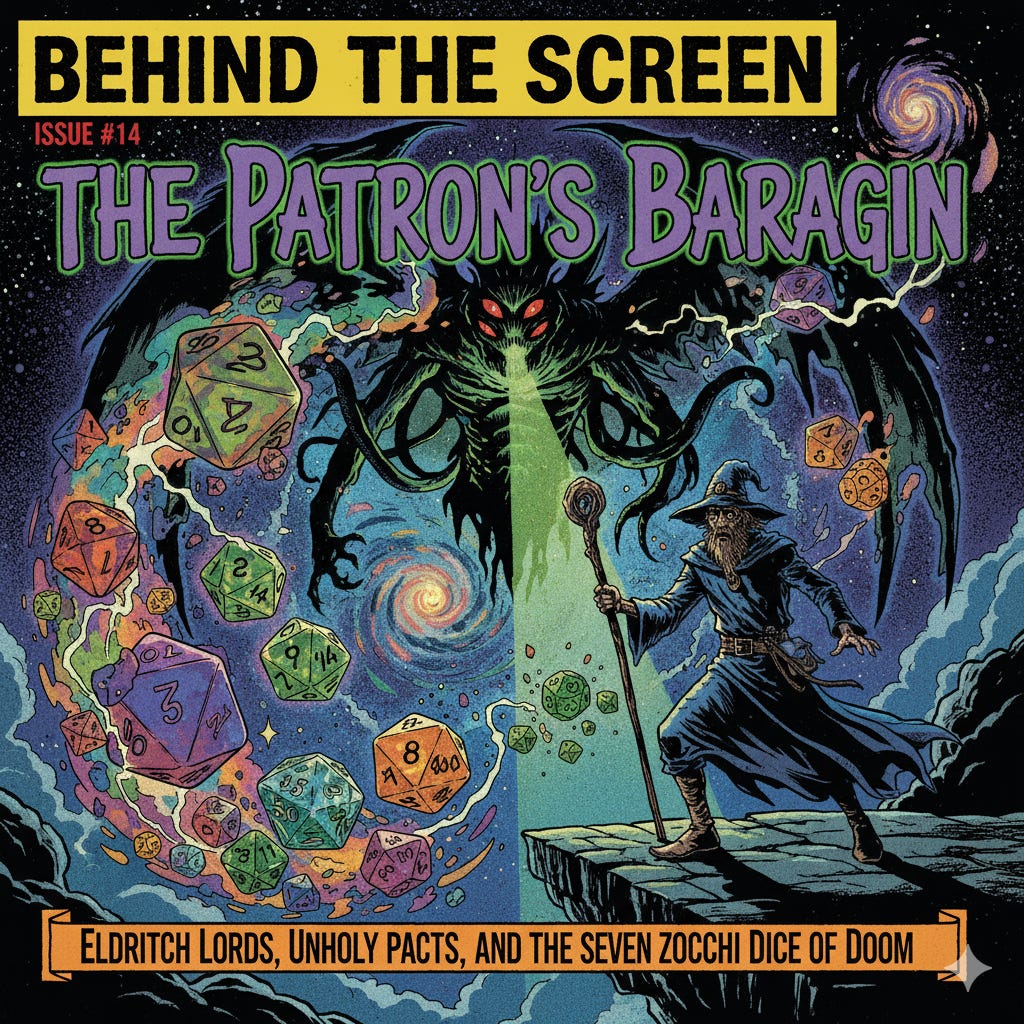
Behind the Screen #14
The Patron's Bargain

Inside This Issue
RPG HQ Meetup V Details
Into the Dungeon
November Event Calendar
Game Runners
RPG HQ Meetup V Details
If you haven’t already made your RSVP for next weekend’s play session, there’s no time like the present! This week we will be hosted by the Wayzata Library. This begins our month’s long focus on Dungeon Crawl Classics by Goodman Games. Check-in opens at 10:50AM, with gameplay beginning at 11:00AM. Play concludes at 3:00PM. As always, no outside materials are required to purchase in order to participate. This week and there couldn’t be a better opportunity to jump in! RSVP here to secure your space at the table next Saturday!
Into the Dungeon
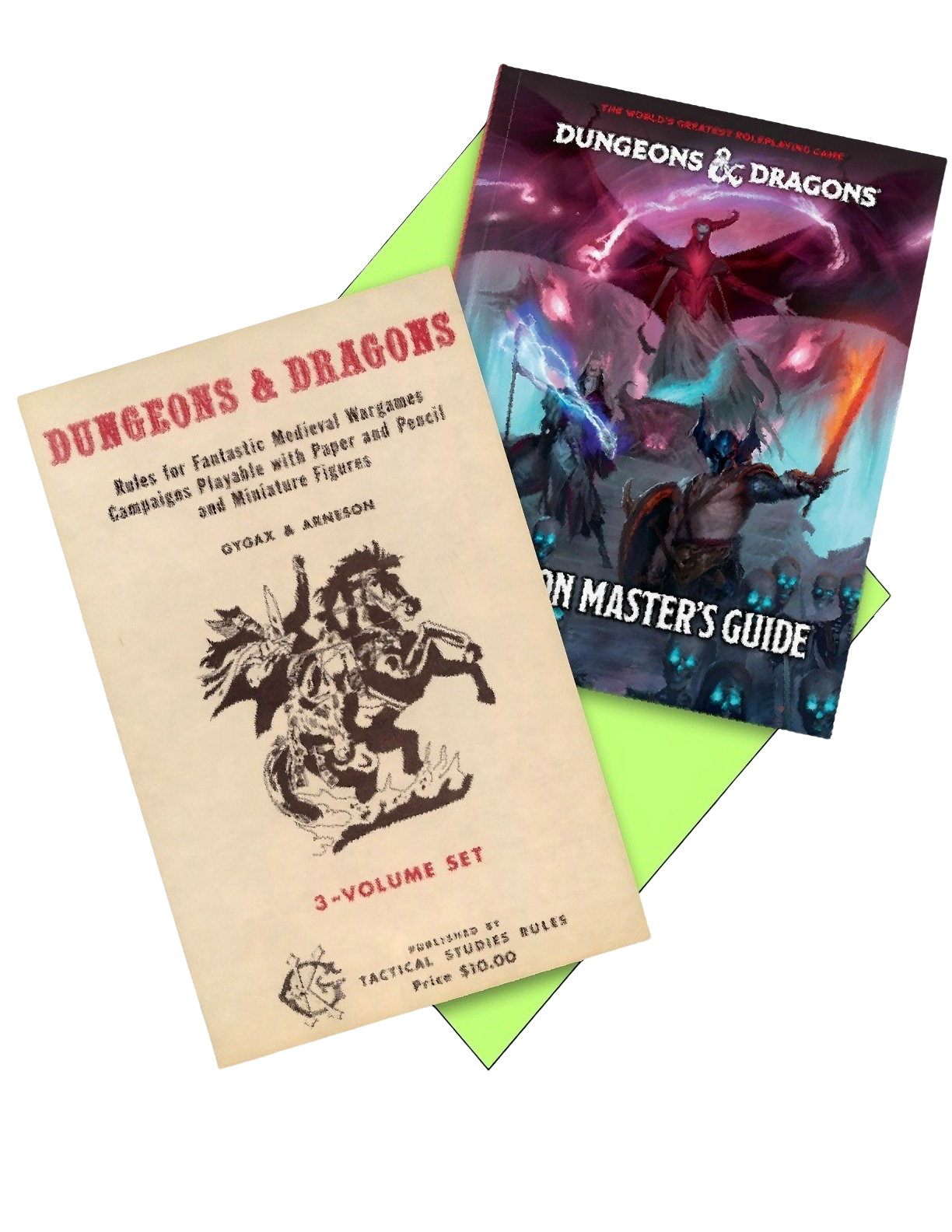
Tabletop roleplaying has been a part of American culture for five decades. The game has been in continuous print since its first release in 1974, but there is a gulf between the most recent, 2024 50th anniversary ruleset, and the game produced by Gary Gygax and Dave Arneson. Over the years everything from mechanics, to artistic style and aesthetic have shifted. It’s all still “D&D,” but some hobbyists find that they yearn for experiences more in line with D&D’s archaic past. Enter Joseph Goodman, game designer and founder of the aptly named Goodman Games.
Background
Back in 2003, Goodman began producing adventure modules for D&D 3rd edition, and quickly set out to harmonize the latest ruleset with the infamous “Appendix N”.
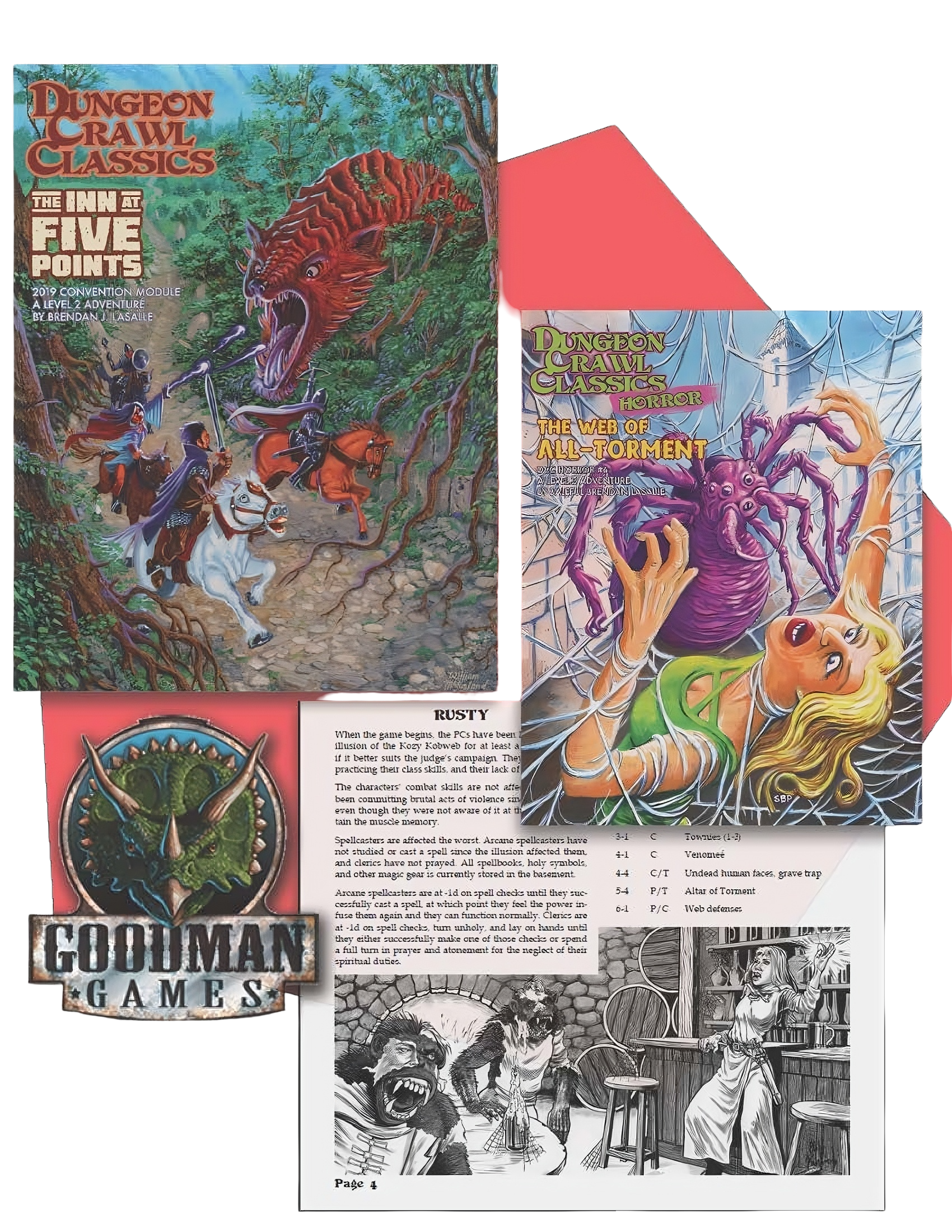
First printed in the 1979 Advanced Dungeons & Dragons 1E Dungeon Master’s Guide; this appendix was a collection of literature that the publishers encouraged any Dungeon Master to read and mine for adding style to their sessions and adventures. Goodman’s modules were well received, and in 2012, Goodman Games launched their own in-house TTRPG rule system—Dungeon Crawl Classics (DCC). What gamers got were thrilling adventures bolstered by dynamic mechanics with a punishing difficulty curve. Stu Horvath, RPG Historian and author of the 2023 book Monsters, Aliens, and Holes in the Ground made the following observation regarding the concept of ‘balancing’ play encounters:
“Dungeon Crawl Classics doesn’t just dismiss balance, it nukes balance from orbit and wages a relentless war on the straggling survivors. Randomness rules here.”
DCC is not a game for staggeringly deep character development, largely due to the deadliness of the gameplay. The game does not pull punches. Famously, the method used to initiate new players is to hand them a literal stack of four 0-level characters, and then metaphorically feed those characters into a dungeon that can best be described as a wood chipper. Any characters who survive win the honor of ascending to level 1 status. These adventures are appropriately known as Meat Grinders.
Core Mechanics
The game’s ethos is vividly described in the following statement which accompanies all printed modules:
“Remember the good old days, when adventures were underground, NPCs were there to be killed, and the finale of every dungeon was the dragon on the 20th level? Those days are back. Dungeon Crawl Classics don’t waste your time with long-winded speeches, weird campaign settings, or NPCs who aren’t meant to be killed. Each adventure is 100% good, solid dungeon crawl, with the monsters you know, the traps you fear, and the secret doors you know are there somewhere.”
DCC is built on the chassis of the familiar D20—Roll High vs. Target Number mechanic; and it is propelled by a unique ‘Weird” Dice Chain, and Chaos Magic engine.
The Dice Chain
There are 7 distinct polyhedral dice in a typical rpg play set: d4, d6, d8, d10, d12, d20, and d100/percentile. DCC employs a Zocchi Dice Set, adding seven more polyhedrals to the pool of available dice: d3, d5, d7,d14, d16,d24,and d30. In application, the Dice Chain is smooths over smaller numerical bonuses or penalties that a character may earn or suffer, and speed the game play up by changing the probability of success by adjusting the size of the pool of possible number outcomes on the die thrown for the action, rather than rolling a single d20, and then adding +2 for proficiency, +x for ability modifier, and +x from that random magical item your character is carrying. Instead of a d20, perhaps your character takes their next action off a d24 because of their recent improvements, while the target number stays the same. As exciting as this mechanic sounds, it is a double-edged blade. The inverse of this principle is in play, and thus when your character becomes impaired, your die size shrinks!
Chaotic Magic
Magic casters are required to perform a Spell Check whenever casting a spell. A player adds the appropriate ability score modifier to their action (d20) roll, and consults that spell’s check table. It is important to note that the chart doesn’t determine the success of the casting, but rather the spell’s intensity upon being cast. In DCC, magic feels alive. Higher results on the check table can grant spectacular augmentations to the spell, like increased number of targets for the casting, increased damage, or other environment-altering effects. A high roll can even change how a spell manifests when the character casts it! Conversely, low results on the table bring less effective results, or even full on miscasts that can have catastrophic, corrupting results on the caster. To influence these unpredictable rolls, casters can engage in a mechanic called Spellburn, temporarily sacrificing points from their physical ability scores (Strength, Agility, or Stamina) to gain a 1-for-1 bonus on their Spell Check. This exchange ensures that power always comes at an immediate, tangible cost.
Magic is never ‘safe,’ made all the clearer by the system’s use of Patrons. All magic comes at a price, and while it is possible to acquire magical knowledge through finding spell books and transcribing them, it is far more effective to glean magical knowledge from a powerful otherworldly being. Patrons grant characters access to different spells, and can serve sound hooks for character-adventure connections. Wizards are effectively dancing on a tightrope suspended between utter damnation (due to corruption) and supreme cosmic power every time they wave their hands while muttering.
Outcome
Dungeon Crawl Classics is a return to the roots of adventure—a-session where the game world is scary, the risks are real, and the dice rolls determine a truly unique fate. DCC is an invitation to embrace the pulp fiction heritage of the hobby and experience fantasy at its wildest form.
November Event Calendar
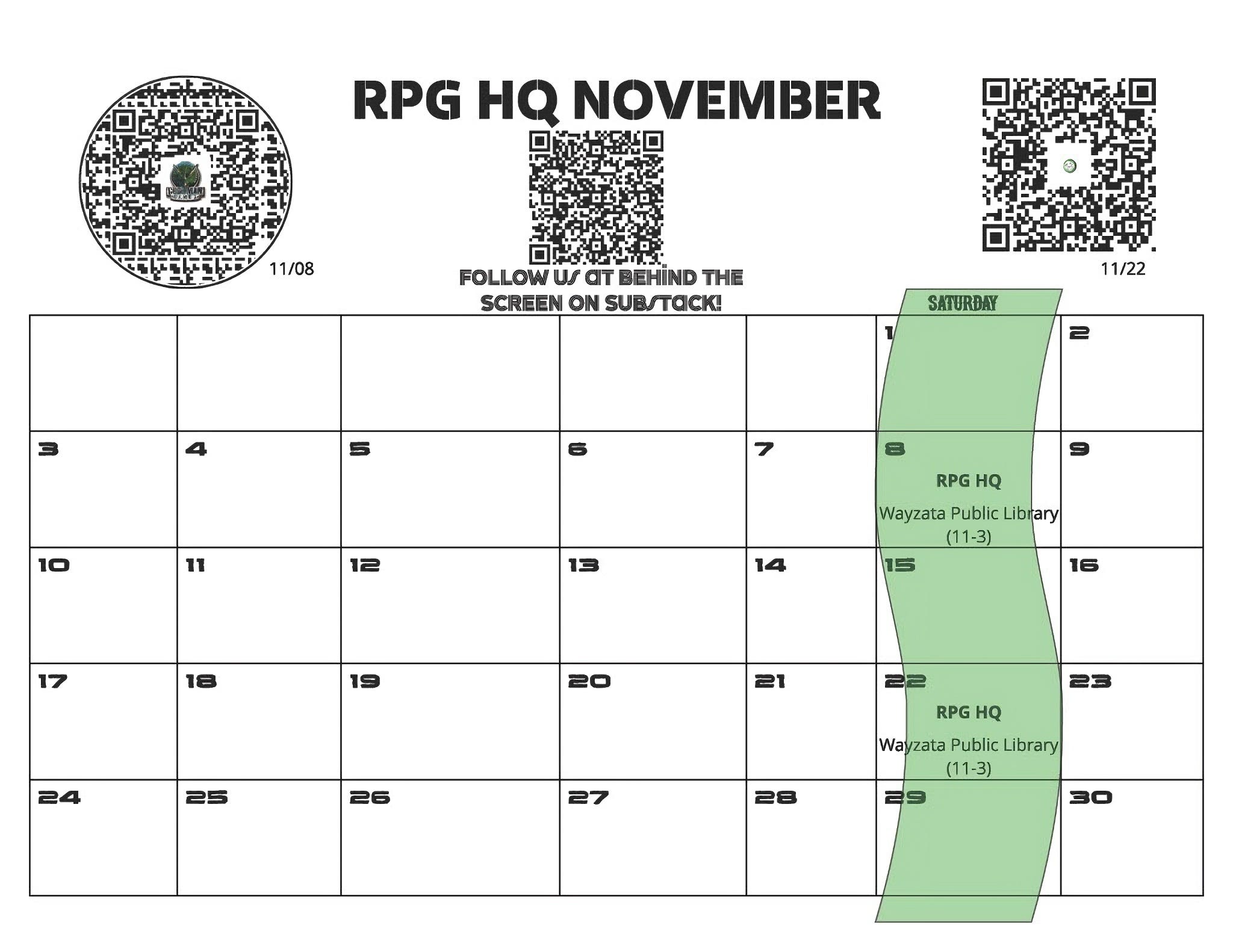
Did you miss our last meetup?
RSVP for one of our upcoming dates!
Saturday November 8th (Wayzata Library)
620 Rice St E, Wayzata, MN
Saturday November 22nd (Plymouth Library)
15700 36th Ave N, Plymouth, MN
**December Dates Soon To Be Determined**
Game Runners Needed!
If you are willing to assist with running a session of any system for peers in the coming weeks, please email the editor at editorbehindthescreen@gmail.com with “Game On” in the subject line.